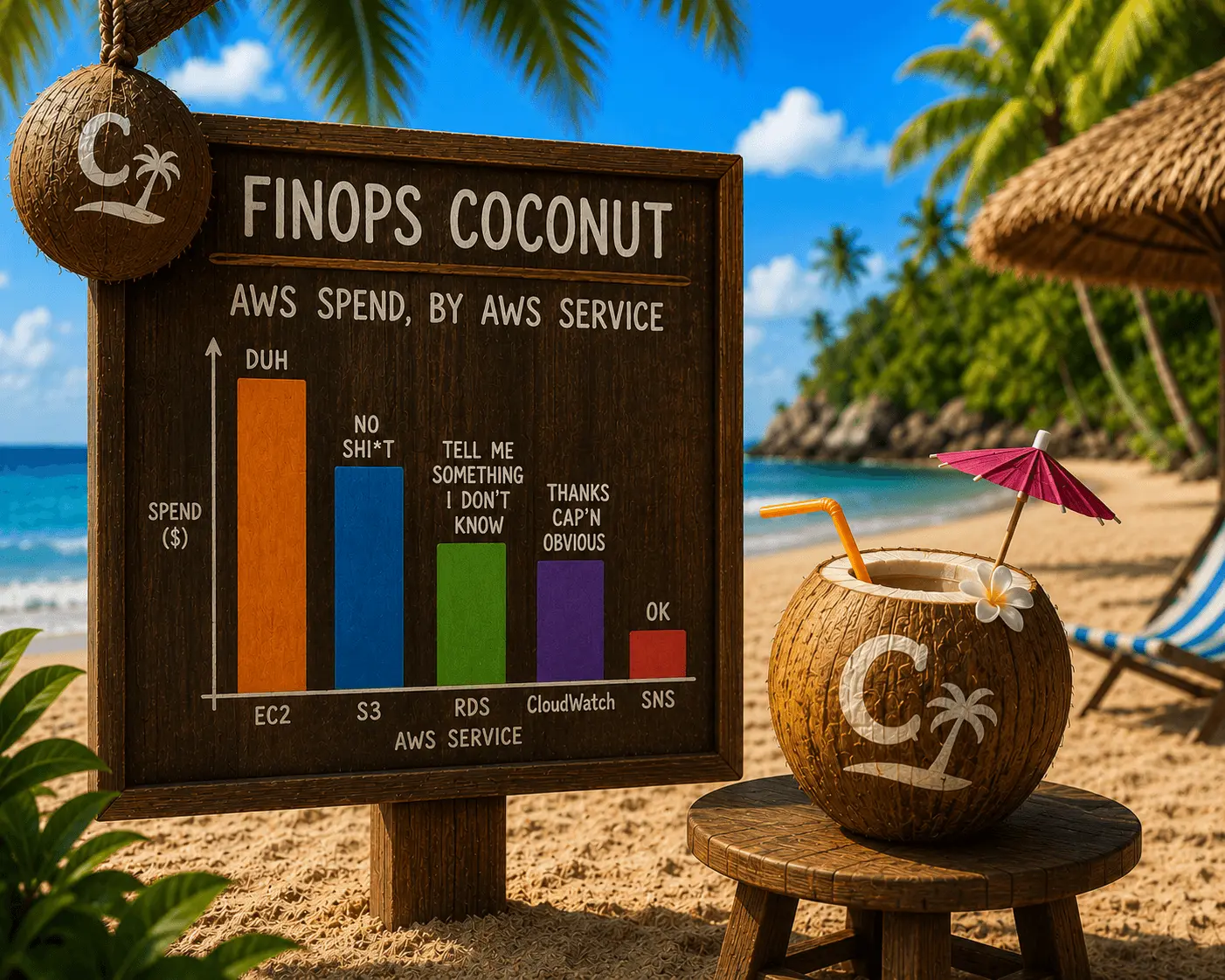
Ever hear of a weather coconut?

FinOps tools are the weather coconut of cloud operations. They tell cloud ops teams little more than what the team already knows — conceptually, a bar chart telling them how their AWS spend breaks down across services. This lack of specificity is why the CFO often leads cost savings "initiatives" or "save-a-thons" which Ops teams hate. Already under the gun to meet product deadlines, ops and engineering teams are now forced to prioritize cost savings tickets against the work they are already behind on.
Risk, or "what could possibly go wrong?"
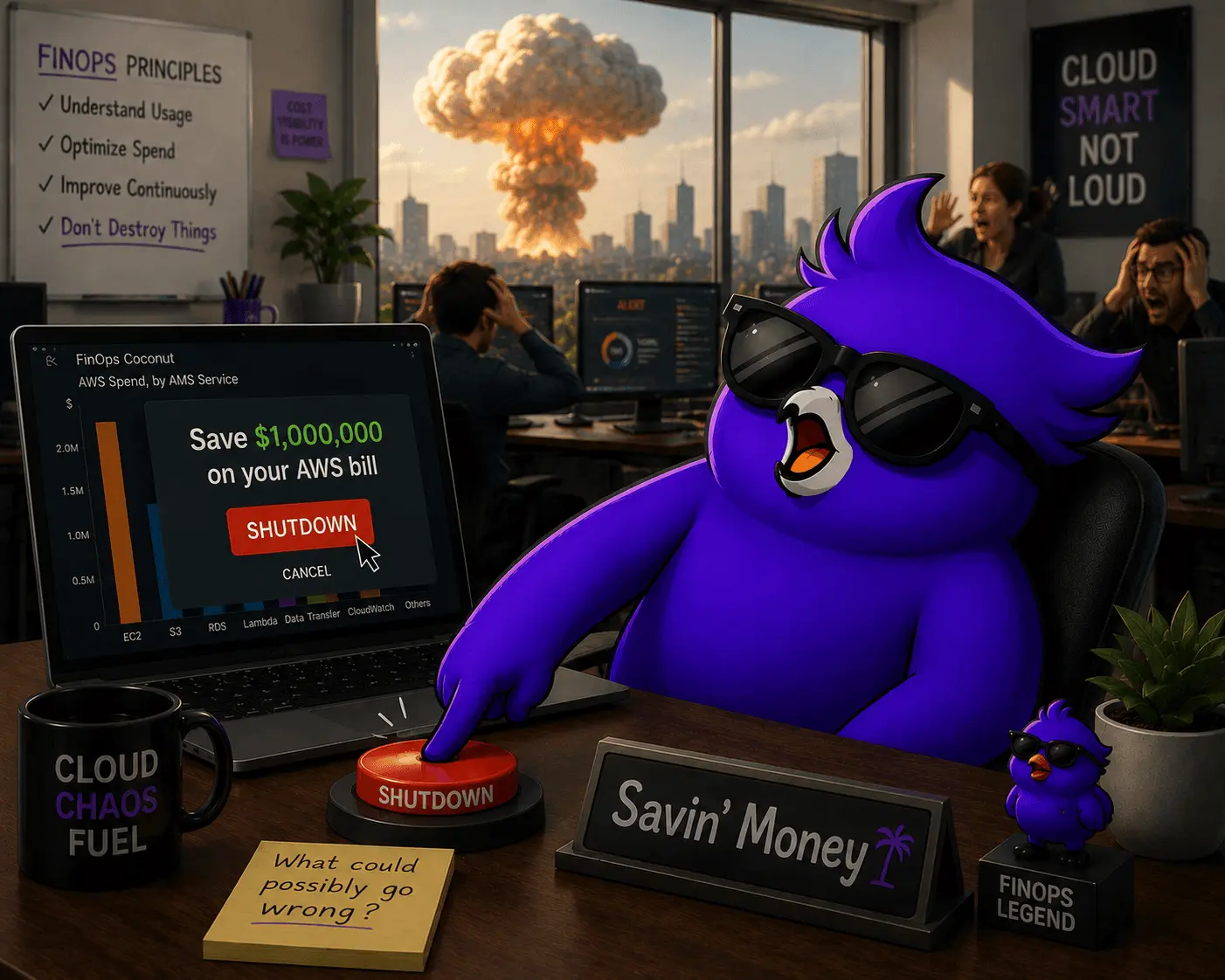
Shutting anything down in the cloud is a risk. To illustrate this point, not gonna say who, but "someone" once shut down an environment by accident, that was critical for a company keynote demo. How did it happen? The monitoring dashboard for the demo environment showed zero activity for months. Easy call right? Let's save thousands by shutting down some idle resource. What could possibly go wrong? Within minutes of destroying the environment with a terraform delete, the audible chatter from the cubicles was "what just happened to our keynote demo". Oooops much? The monitoring dashboard for the demo had been copy-pasted from a prior environment. So we were looking at the wrong metrics, and killed an active, arguably critical, environment. Hard lesson: killing ANYTHING in the cloud is a risk. The battle scar that CloudOps takes away is "I'd rather waste LOTS of money than risk my neck."
So what's the fix?
Existing tools don't sufficiently marry the resource, cost, pricing, and meaning of resources, rendering these tools little more than a weather coconut of cloud cost. Moving beyond the weather coconut is where AlertD excels. As we talked about in our last post, AlertD ingests every resource in your AWS account, and links it to both the complete AWS pricing dataset and live and historical CloudWatch metrics. AlertD also semantically understands all your resources, and it does not depend on tags for this understanding. This means that even without good tags, AlertD can understand the context, from its peers and its environment, of what this resource is for and, how it's being used NOW, YESTERDAY, and over the past 30 days. This information is joined with detailed pricing data, not "ballpark" figures.
But don't trust your lying eyes when it comes to cost savings recommendations. AlertD allows you to drill into resource usage metrics, and chat with Flappy to increase your confidence and build a rock-solid case for rightsizing and shutdown, based on real evidence and accurate pricing, not hearsay. So let's dig in and see how AlertD cost optimization works.
Why push the button yourself when a coding agent can do it for you? More than 40% of new Infrastructure as Code (IaC) is authored by AI, and Gartner expects a third of enterprise software to be agentic by 2028. AlertD can drop cloud cost optimization instructions directly into Claude Code or the coding agent of choice.
Intro to AlertD cost optimization
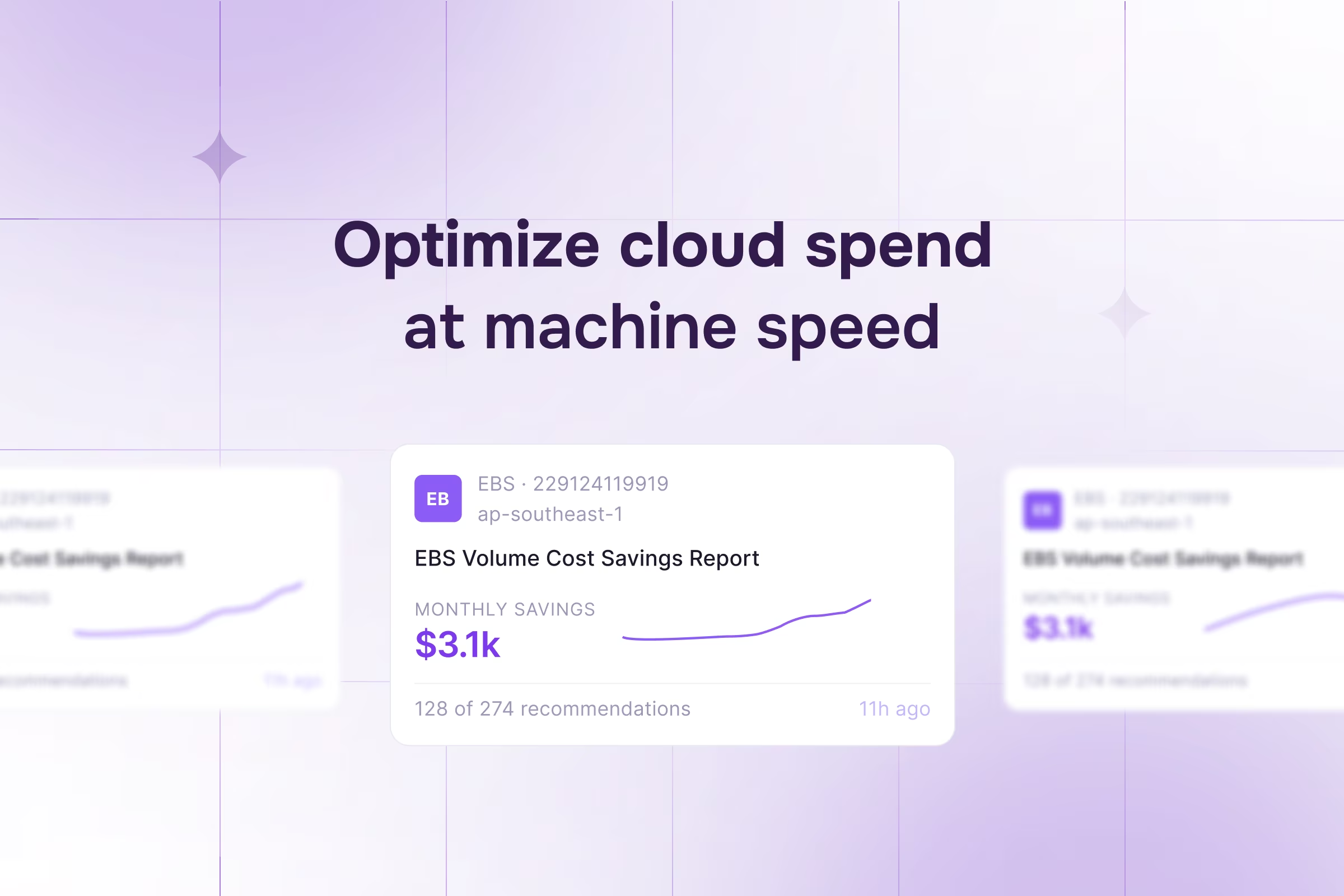
AlertD's core cost savings recommendations are all generated with zero manual configuration, and are updated daily.
The screenshots below are from a real AWS customer environment. This customer spends millions of dollars per year on AWS. We've anonymized and removed confidential data from all screenshots.
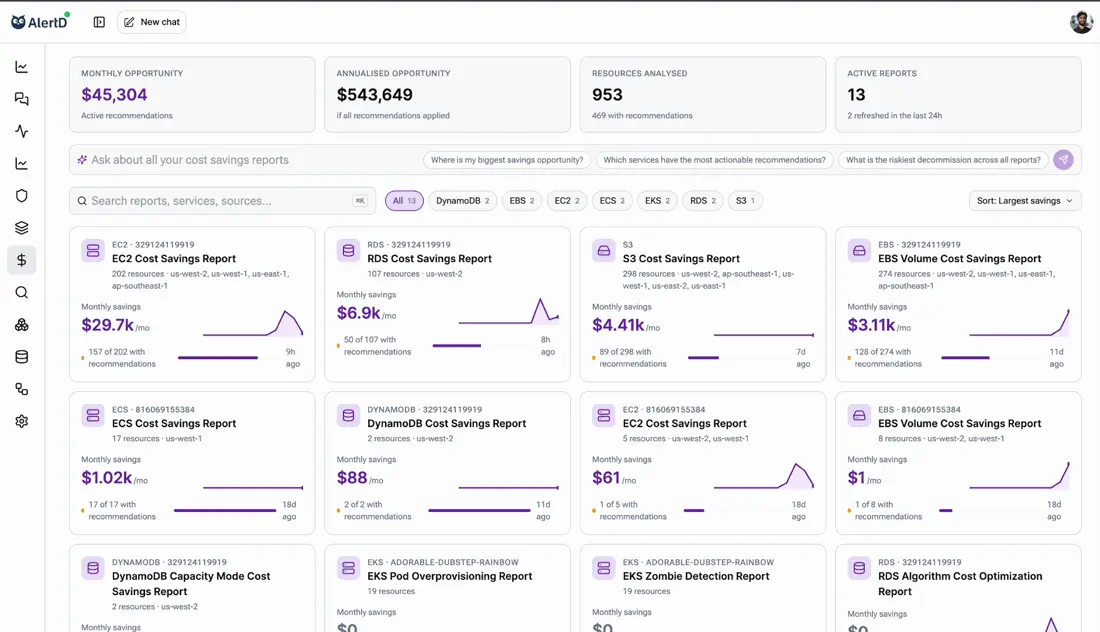
The Cost Savings home: opportunity totals at the top and a savings report for every service below, all kept up to date. Every recommendation comes with evidence (idle time, usage, and CloudWatch metrics), so you judge the risk in seconds. One database here had been idle for 322 days, worth about $800 a month. And when we say it's idle, the live and historical metric proof points are just a click away. No need to engage engineers or other teams for verification.
Auto classification for the win

Most cloudops teams have crummy tagging hygiene. Fortunately, AlertD's agent, Flappy, excels at inferring and autoclassifying resources. That's why, even in a total absence of tags, Flappy figures out how to group, sort, slice and dice your resources better than Benihana.
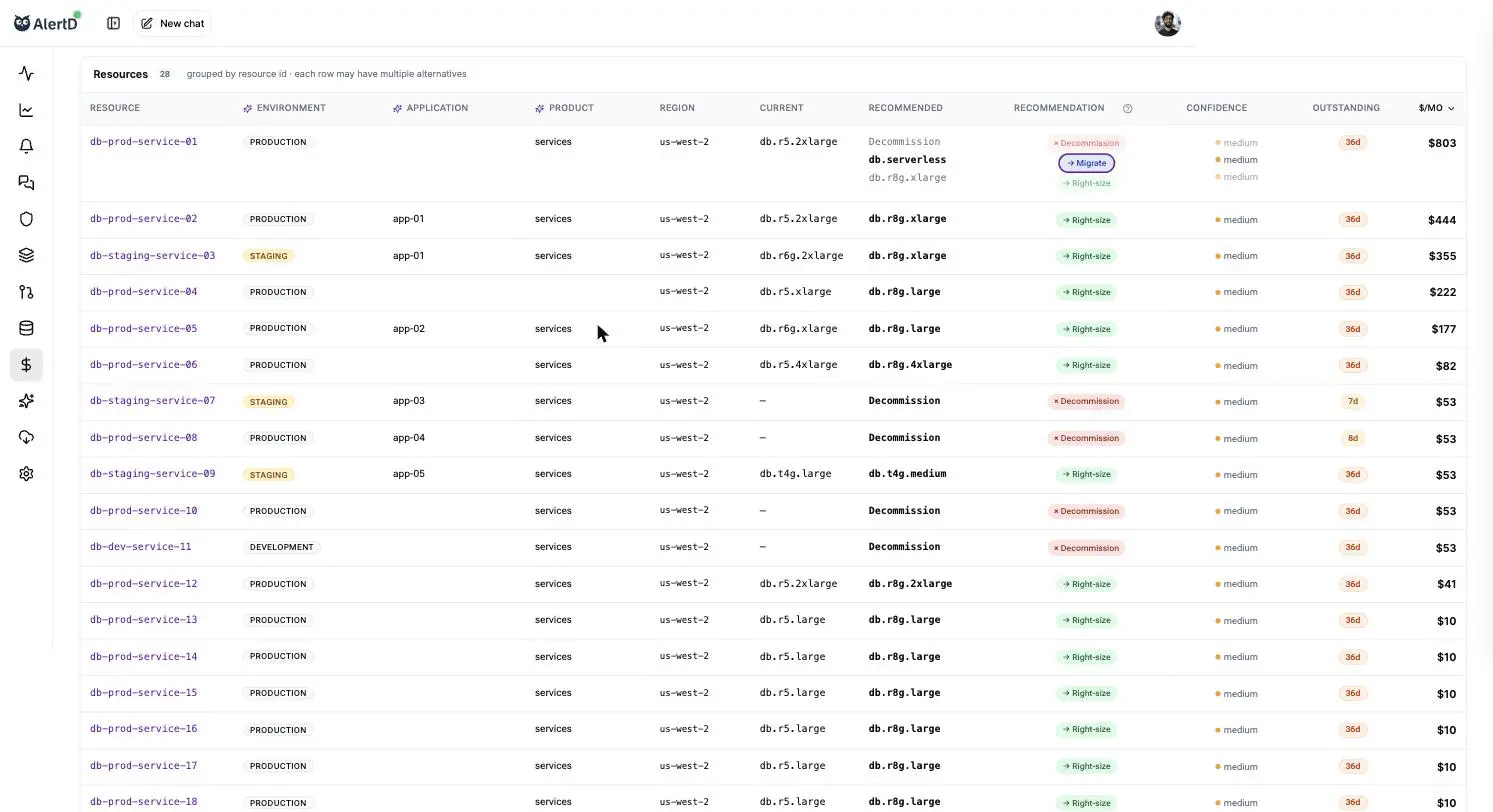
In the image below you see columns for ENVIRONMENT, APPLICATION, TEAM, and CLUSTER. These are all auto-classifications that Flappy infers automagically. There is no "fixed tagging scheme" you have to implement. AlertD 'just works' regardless of your tag hygiene.
Autoclassifications enable you to group your cost savings by important dimensions like team, and application.


Many resources have more than one safe option (decommission, migrate, or right-size), each with its own saving, and each row shows how long it has waited.
Net Net
AlertD marries resources with a unique understanding of historical performance, costs, and semantic meaning of resources. Said another way, Flappy understands what your resources are actually FOR. So when it makes recommendations on cost savings, those recommendations blow the FinOps coconut out of the water. And you get it all with zero setup, zero configuration, and zero additional investment of your team's time.
AlertD is available on AWS Marketplace as AI for cloud operations. Learn more →
Frequently asked questions
What is agentic cloud cost optimization?
Always-on AI agents analyze your cloud, find savings with evidence, and generate the steps to apply them. That turns hours of work into seconds, while a human approves the final action.
How much cloud spend is typically wasted?
About a quarter to a third. A 2025 report put cloud infrastructure waste at $44.5 billion, mostly the gap between finding savings and applying them.
Why do most FinOps recommendations go unimplemented?
Applying them is manual, risky, and slow. It loses to the roadmap, and the cloud changes faster than reviews can keep up, so they pile up unused.
What are "outstanding" and "missed" cloud savings?
Outstanding savings are recommendations no one has applied yet. "Missed to date" is what they've already cost while waiting, since savings add up every day a fix is delayed.
Do AI agents change your cloud automatically?
No. AlertD stays read-only and never changes anything itself. It integrates with coding agents to implement the actioning.
Sources: State of FinOps 2025 (FinOps Foundation); "FinOps in Focus," $44.5B cloud waste projection (Harness, 2025); cloud cost analysis benchmarks (Cloudaware, 2026); Gartner, AI code assistants and agentic AI forecasts (2024–2025); State of Code 2025, AI-generated code share.